




















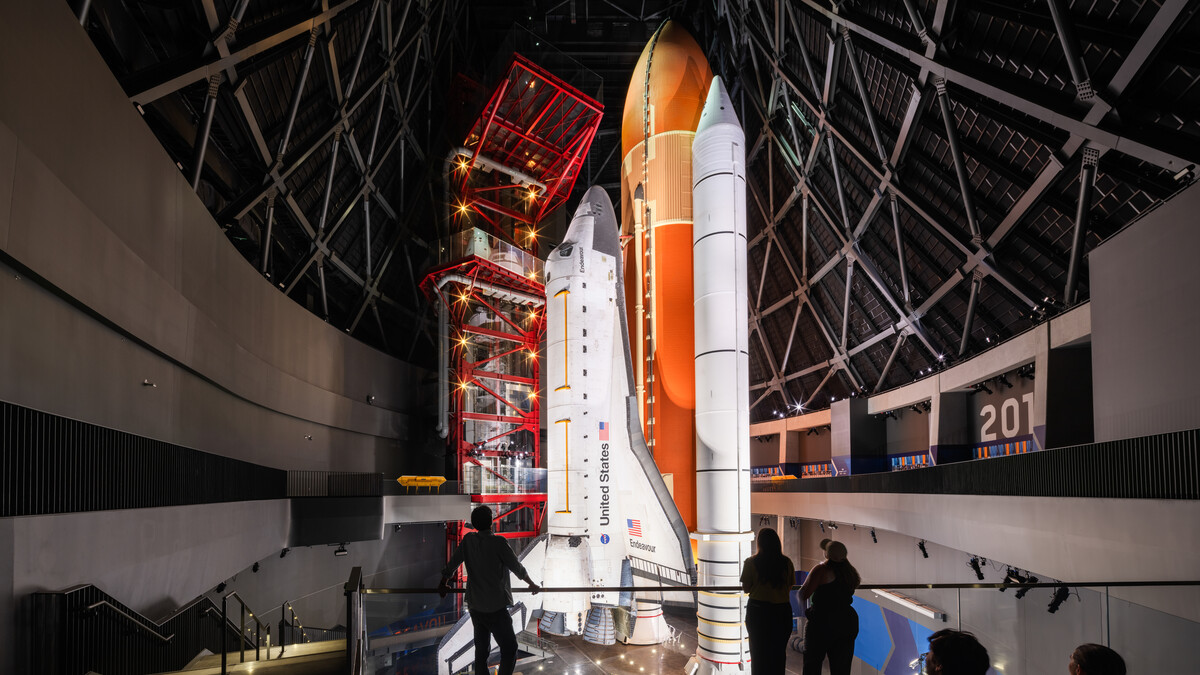
It was Media Day at the California Science Center in Los Angeles for the unveiling of Space Shuttle Endeavour in its breathtaking new launch configuration. The display is the centerpiece of the new Samuel Oschin Air and Space Center, which will open to the public on November 13, 2026.
After refreshments, members of the media were ushered into a spacious gallery dominated by an enormous screen. We were welcomed by Lynda Oschin, chair of the Oschin Family Foundation, and Los Angeles County Second District Supervisor Holly Mitchell before the presentation began.
The introductory film was created by Bad Robot, the production company led by J.J. Abrams. It was everything I hoped it would be. The film traced the remarkable life of Endeavour and the Space Shuttle Program, which flew from 1981 until its final mission in 2011. As the film reached its emotional conclusion, the audience erupted into applause. Then the screen slowly lifted.
Everyone saw the exhibit for the very first time. The cheering gave way to silence.
The entire building felt less like a museum and more like a cathedral devoted to space exploration. Inside the soaring 20-story eggshell dome, all I could hear were footsteps and the occasional involuntary gasp as visitors absorbed the sheer scale of what stood before us.
Visitors entered a circular gallery that wrapped around the shuttle. From there, the stairs [and a conveniently placed elevator] lead down several levels, allowing guests to view Endeavour, its massive external tank, and its solid rocket boosters from remarkably close range.
At the far end of the exhibit is a gantry elevator that was not yet operating during Media Day. When it opens to the public, it will lift visitors to a platform extending beside the orbiter, offering a rare opportunity to experience what astronauts felt as they entered the shuttle through its main hatch.
Walking around the main ring, I listened as people shared their reactions. There are several Space Shuttles on display across the United States, but none quite like this. The California Science Center has displayed Endeavour before, suspended horizontally as though it were gliding overhead. Now it stands proudly in its authentic launch position, fully “stacked” with its ET-94 external fuel tank and twin solid rocket boosters. Because ET-94 is the last flight-qualified external tank in existence, this complete launch stack can never be recreated anywhere else, making the Samuel Oschin Air and Space Center a must-see destination for anyone fascinated by aviation or spaceflight.
Along the rear section of the gallery are artifacts from the Shuttle Program, including an impressive wall displaying all 135 shuttle missions.
As I studied each mission, I realized something. I was ten years old when the first Space Shuttle launched. The Apollo 11 Moon landing had taken place just a year before I was born. Looking across those missions, I understood that this truly was Generation X’s space program. We grew up wearing shuttle T-shirts and baseball caps. We watched launches on classroom televisions and dreamed of becoming astronauts.
Then I reached one mission on the wall: Challenger. January 28, 1986.
I was in high school. We watched it happen live. I will never forget that day. While speaking with one of the exhibit volunteers, I mentioned the Challenger disaster. They quietly replied that it was “our generation’s Kennedy assassination.” Everyone remembered exactly where they were.
Standing on the ground floor, you can almost touch the shuttle’s three massive main engines. Walking beneath them, you finally appreciate the true scale of the spacecraft. They seem to envelop you.
Several additional exhibits and artifacts tell the story of the Shuttle Program, although portions of the museum were still behind curtains as crews worked toward the November opening. In some areas photography wasn’t yet permitted, but I can honestly say that what I saw will delight anyone who has ever been inspired by flight or looked toward the stars with curiosity.
As I left the Samuel Oschin Air and Space Center and headed toward the parking lot, I ran into another reporter I had seen inside. I asked him what he thought of the exhibit. He smiled and said, “Sometimes I have to cover things I really don’t want to. But this… brought out my inner child. I was a kid again.” Well said, my friend.
The California Science Center remains free to the public, although traveling exhibits and the IMAX Theater require paid admission. For this visit, I decided to take Metro from my hometown of Pomona. With the new station now open, my total cost, including parking and train fare, was only $6.50. I didn’t have to fight Los Angeles traffic, and I enjoyed reading during the ride. I exited at Expo Park/USC Station, walked through the beautiful Rose Garden, crossed the street, and arrived at the Science Center.
I wholeheartedly recommend both the journey and the destination.
By Charles Spratley