






















A newly introduced piece of California legislation, California Assembly Bill 2624, is quickly becoming one of the most debated bills of 2026 which is raising fundamental questions about transparency, accountability, and the role of citizen journalism in a modern society.
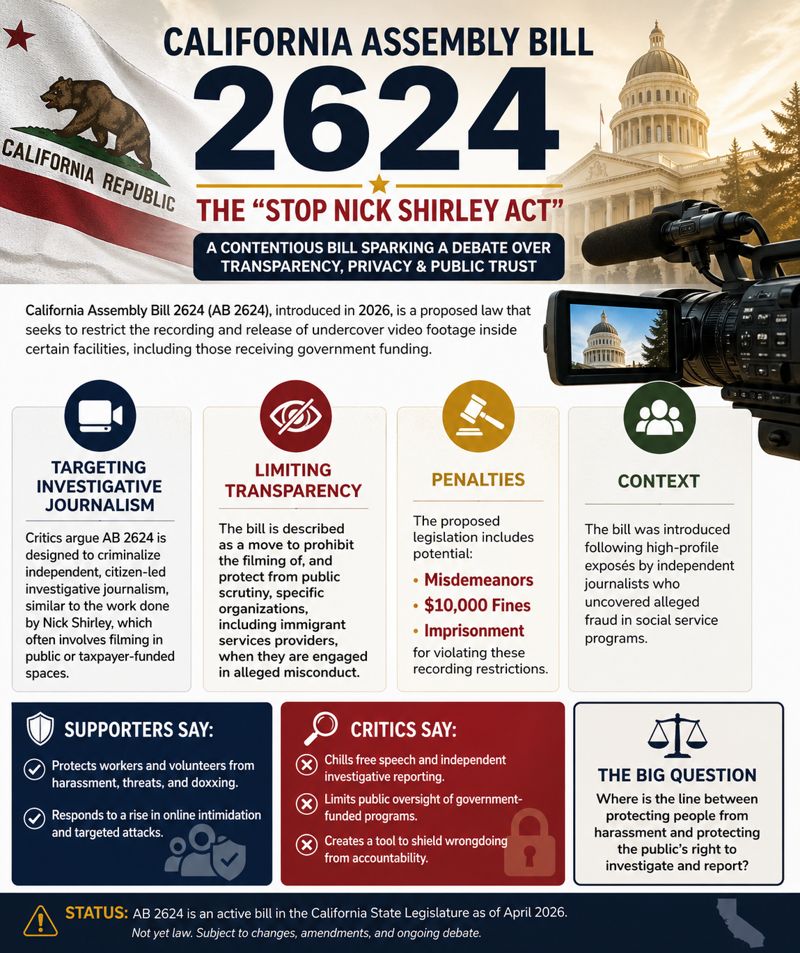
Dubbed by critics as the “Stop Nick Shirley Act,” a nickname popularized by Carl DeMaio, the bill has drawn sharp reactions across political and civic circles. While the title itself is unofficial, the concerns behind it reflect a broader unease about where the line is being drawn between public oversight and personal privacy.
At its core, AB 2624 seeks to expand protections for certain individuals and organizations, particularly those involved in immigration-related services by limiting the ability to publicly share identifying information or footage if it is deemed to be used with intent to harm. Supporters argue the bill is necessary to protect workers and volunteers from harassment, threats, and targeted intimidation in an increasingly heated public environment.
However, critics see something very different. They argue that the bill, whether intentionally or not, could restrict the kind of independent, citizen-led investigative reporting that has gained traction in recent years. Content creators such as Nick Shirley have built large audiences by documenting and exposing alleged misconduct within publicly funded programs often using video recorded in spaces accessible to the public.
For those critics, the concern is not simply about privacy it is about access. Questions have been raised about whether limiting the recording or distribution of such footage, particularly in facilities receiving taxpayer funding, could reduce transparency at a time when public trust in institutions is already strained. Some interpretations of the bill warn of potential penalties including fines and misdemeanor charges if certain thresholds are met, though legal standards such as “intent to harm” would play a central role in enforcement.
The timing of the bill has also added to the controversy. Introduced in the wake of several high-profile exposés alleging fraud or misuse within social service systems, AB 2624 is being viewed by some as a direct response to those investigations. That context has fueled a broader public conversation, one that extends well beyond Sacramento.
In recent months, public demonstrations across the country have emphasized themes of accountability and resistance to perceived overreach. At the same time, legislation like AB 2624 is prompting a different question: how does a society balance calls for transparency with the need to protect individuals from targeted harm? It is not a simple issue, nor is it a settled one.
Supporters of the bill maintain that privacy protections are essential in an era where online exposure can quickly escalate into real-world threats. Critics counter that limiting the public’s ability to document and question institutions particularly those funded by taxpayers, risks creating blind spots where accountability should exist.
As AB 2624 continues to move through the legislative process, it remains just that, a proposal, not law. Amendments are expected, and debate will likely intensify in the weeks ahead.
For residents of California, including communities like La Mirada, the conversation is a reminder of something deeper: that civic engagement is not just about policy, but about principles. Transparency and safety. Oversight and protection. Rights and responsibilities.
In the end, the outcome of this debate may shape not only how information is shared but how trust itself is built, maintained, or lost.