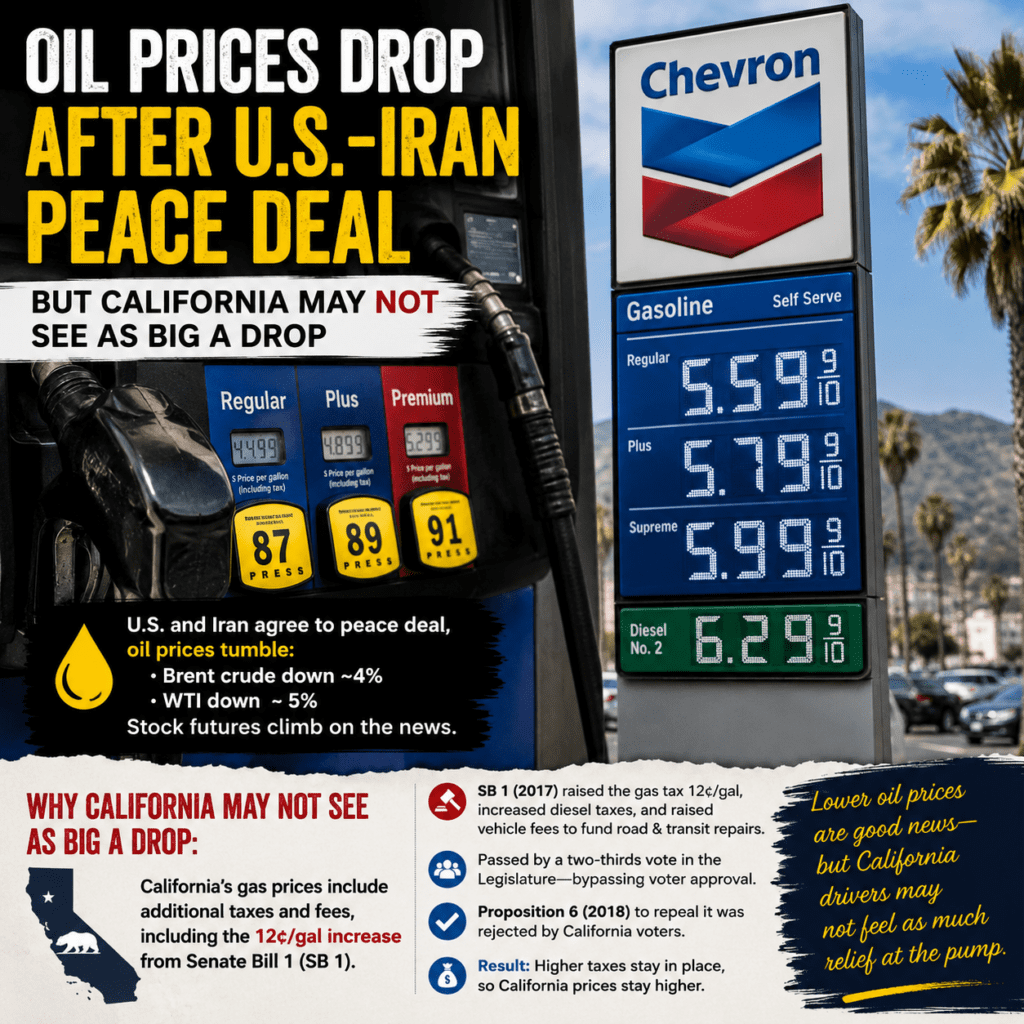

























Global oil prices fell sharply last month after the announcement of a new agreement between the United States and Iran aimed at easing tensions in the Persian Gulf and reopening critical shipping lanes.
Brent crude oil, the international benchmark used to price much of the world’s petroleum, dropped approximately four percent following the news. West Texas Intermediate (WTI), the primary U.S. benchmark, also declined significantly as markets reacted to expectations of increased oil flow through the region.
The agreement includes the reopening of the Strait of Hormuz, one of the world’s most important energy corridors. The narrow waterway connects the Persian Gulf to international shipping routes and serves as a transit point for a substantial portion of the world’s oil exports.
Financial markets responded positively to the announcement, with stock futures rising as investors anticipated greater stability in global energy supplies. Analysts noted that energy markets are highly sensitive to disruptions in the Strait of Hormuz because even temporary interruptions can affect fuel prices worldwide.
Lower oil prices often translate into reduced costs for gasoline, diesel fuel, airline operations, shipping, and manufacturing. While consumers may not see immediate price changes at the pump, sustained declines in crude oil prices can eventually help ease transportation and energy expenses.
The development comes after months of concern over instability in the region and its potential impact on global energy markets. By restoring access to key shipping routes, the agreement may help reduce uncertainty that has contributed to price volatility.
Economists caution that energy markets remain influenced by a variety of factors, including global demand, production levels, geopolitical developments, and seasonal consumption patterns. Nevertheless, the announcement was widely viewed as a positive signal for international trade and economic stability.
While falling oil prices could eventually reduce gasoline costs nationwide, California motorists may not experience the same level of savings seen in other states. California’s fuel prices are influenced by several factors beyond the cost of crude oil, including state fuel taxes, environmental regulations, refinery capacity, and transportation costs.
One significant factor is California’s Road Repair and Accountability Act of 2017 (SB 1), which increased gasoline and diesel taxes and raised vehicle registration fees to fund road, bridge, and transit infrastructure improvements throughout the state.
The legislation was approved by the California Legislature with the constitutionally required two-thirds vote and took effect without a statewide vote. The measure later became the subject of Proposition 6 in 2018, which sought to repeal the fuel tax increases and require future transportation-related tax increases to receive voter approval. California voters rejected Proposition 6, leaving the SB 1 funding structure in place.
As a result, even when global oil prices decline, California drivers often continue paying some of the highest gasoline prices in the nation due to a combination of taxes, regulatory requirements, and market conditions unique to the state.
Industry analysts note that lower crude oil prices can still provide some relief at the pump, but the impact is often less dramatic in California than in many other parts of the country.