











Andrew McNally was born in Armagh, Ireland, in 1836. At just 14 years old, in 1850, he entered into a seven-year indentured apprenticeship with John McWatters, a well-known printer, publisher in Armagh, Northern Ireland. Because of Andrew’s young age, his father was required to formally agree to the terms of the apprenticeship. During this demanding period, McNally earned only eight shillings per month, totaling just 40 pounds for all seven years, the equivalent of about $1,650 today.
In 1858, shortly after finishing his servitude agreement terms, McNally immigrated to the United States. He originally resided in New York City. He moved to Chicago to work at the Chicago Tribune where he met William Rand and became a naturalized citizen on November 8, 1864. In 1868, he became a partner in the Rand McNally Publishing Company. The Great Chicago Fire of 1871 placed a major strain on the publishing firm but eventually became successful in publishing maps, atlases and railroad guides.
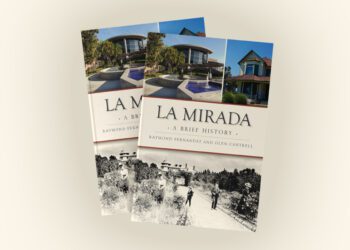
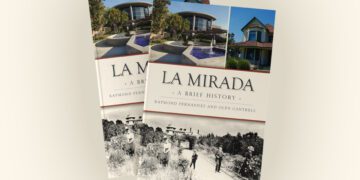
Although based in Chicago, McNally was drawn to California in the 1879-1880 timeframe. He played a significant role in the development of Altadena by purchasing land where he lived on “millionaire’s row.” However, McNally’s ambitions extended even further. McNally envisioned establishing a “Gentleman’s Colony” in the Los Angeles area, a carefully planned community set amid open land and scenic beauty. McNally published “The Country Gentleman” to advertise these estates extolling the beauty and climate of La Mirada.
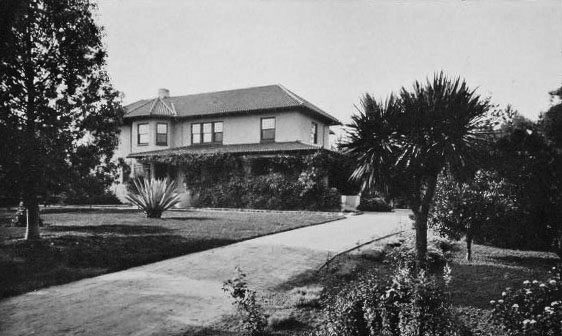
Between 1888-1893, McNally completed the purchase of nearly 2,300 acres of rangeland from the Abel Stearns Rancho. A Western Union telegram from Colonel Robert “Diamond Bob” Northam to Andrew McNally records this historic transaction. McNally named the land “La Mirada,” a Spanish phrase meaning “The View.” His vision included 20-acre estate parcels centered around Windermere Lake, located on what is now the Hutchinson School campus. In 1892 McNally commissioned F.L. Roehrig, the millionaire’s architect, who built his Altadena estate and the La Mirada Santa Fe Railroad Station, to build the Neff Mansion, which was deeded to his son-in-law Edwin Neff and daughter Nanny, which still stands to this day and was added to the National Register of Historic Places around 1978.
In 1896, McNally started the La Mirada Land Company. However, when sales of the gentleman’s estates proved slow, McNally adapted his plans and established the Windermere Ranch. The land was planted with orange, lemon, grapefruit and olive trees. In 1904 McNally caught pneumonia while dining at the ritzy California Club and died two days later on May 7. However, his agricultural operation remained active until about 1953, when the property was sold to developers who built the tract homes that define much of La Mirada today.
Dick Hurley, an early La Mirada newspaper publisher, once stated “If Andrew McNally could see his ‘dream come true’ and the rebirth of his La Mirada townsite and orchard land today, truly he would see the fulfillment of his objective as put forth in his book, ‘The Country Gentleman.’ ‘The object of this pamphlet,’ he wrote, ‘is to call attention of the public to the unrivalled attractions … of the La Mirada estate … as a place for residence; McNally further stated in his pamphlet ‘Everything that can be grown in California can be grown in La Mirada, but the ever-graceful, ever-green olive will always rank first in beauty and utility “. We still enjoy the beauty y of these olive trees to this day.
McNally famously proclaimed in 1893 when he bought the land, “On this site someday a city shall rise!” In 1960 McNally’s vision came to fruition, exactly 102 years after he first arrived in the United States La Mirada officially incorporated as a city. The rest, as they say, is La Mirada history.